Whatsapp/Tel:+86 13853146766
 English
 Spanish
 Persian
 Hebrew
 Russian
 Portuguese
 French
 Vietnamese
 Thai


CNC/servo busbar machines cut measuring and changeover time. Measure conforming parts, yield and changeover—not stroke speed—on 303U/503U/803U-3-C.
Topic: CNC / servo busbar efficiency · metrics · changeover · FAT comparison
Brand focus: busbarmc / LTMC 303U-3-C · 503U-3-C · 803U-3-C
Content layer: Article + HowTo + FAQ (GEO / AISEO)
A CNC or servo-assisted busbar machine improves efficiency mainly by cutting repeated measuring and positioning, shortening repeat-order setup, and executing confirmed coordinates more consistently. Measure benefit with minutes per conforming part, operator minutes, first-pass yield, changeover time, rework, and net copper loss—not punch stroke speed alone. On busbarmc 303U-3-C / 503U-3-C / 803U-3-C class machines, HMI/PLC bend modes and optional servo stops help most when drawings recur.
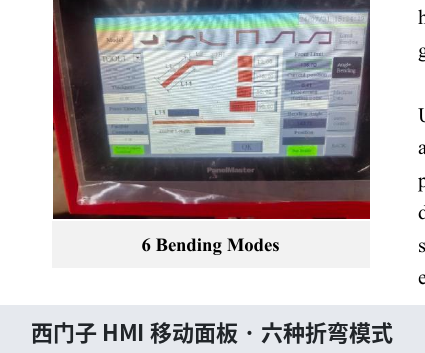
Siemens HMI mobile panel: bending modes screen
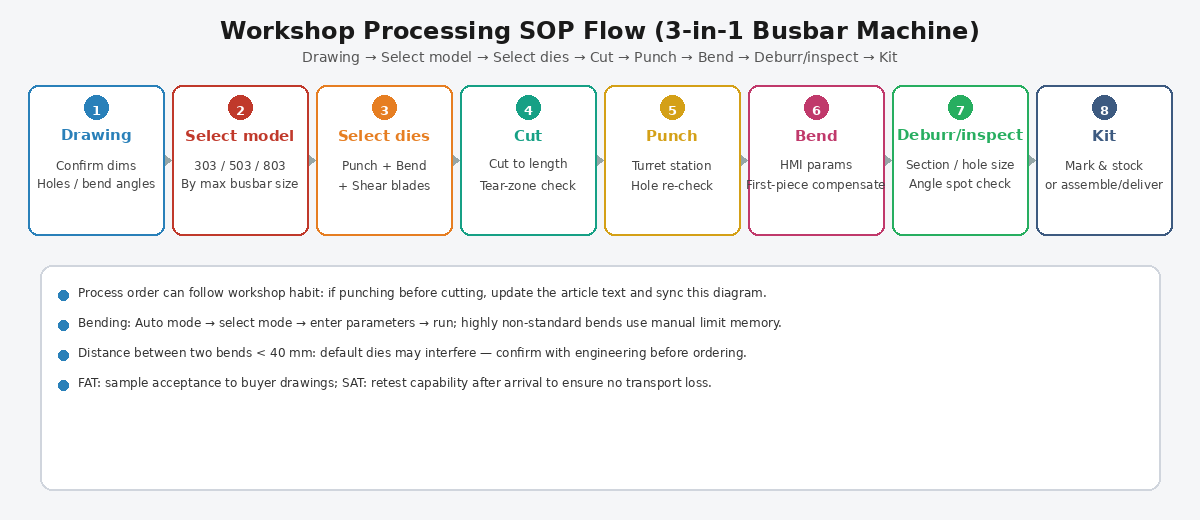
Workshop SOP flow: Drawing → Cut → Punch → Bend → Inspect
CNC / servo may control length stops, hole coordinates, bend stroke/angle recipes, or stored programs—depending on configuration. It does not automatically mean automatic loading, tool change, or inspection. List every controlled axis and remaining manual step in the quotation.
Hydraulic force and CNC control are not mutually exclusive: many efficient cells use hydraulic stations with CNC/servo positioning and PLC bend libraries.
| Lever | What improves | Record this metric |
|---|---|---|
| Automatic / servo positioning | Less marking & ruler work | Positioning minutes per part |
| Stored programs | Faster repeat orders | Program-to-first-conforming-part |
| Prepared changeovers | Model A → Model B | Full changeover clock |
| Data / DXF import (if offered) | Less re-keying | Import → verified program time |
Only count axes that are truly CNC-controlled. Manual stations stay inside complete cycle time.
Evaluate under fixed drawings, material, tooling, operator, and inspection rules:
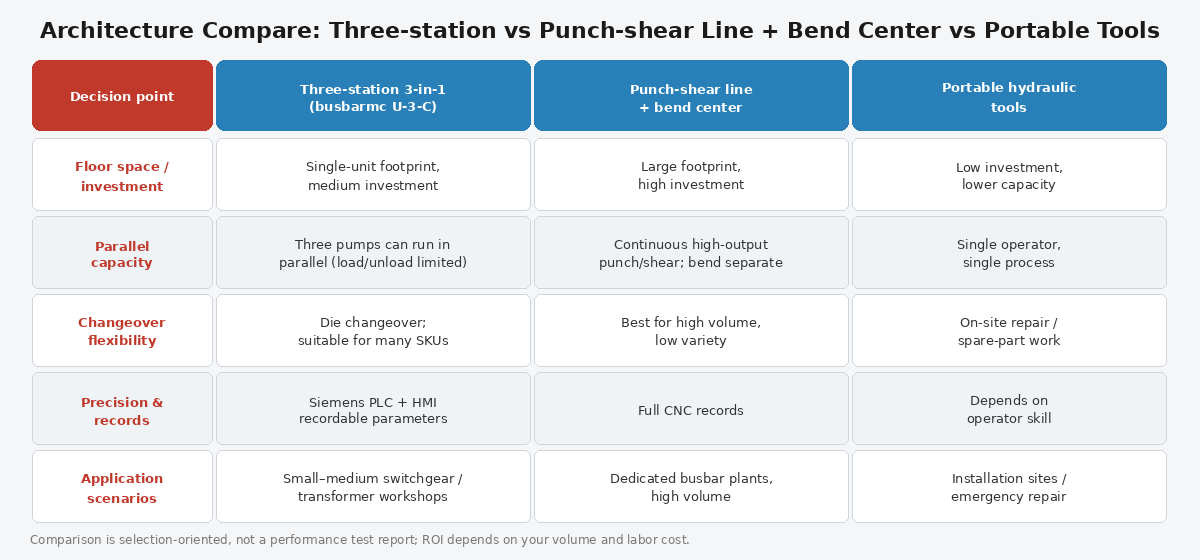
Architecture compare: 3-in-1 vs dedicated vs portable
| Application | CNC saves time when… | Limitation |
|---|---|---|
| Switchgear panels | Breaker-hole kits & cabinet recipes recur | Drawing revision control |
| Transformers / distribution | Long/heavy bars need fewer re-measures | Still need support & capacity |
| Energy storage | Dense compact hole maps | First-article still mandatory |
| Mixed SME shop | Recipes cut setup chaos | Low-volume one-offs may not pay back |
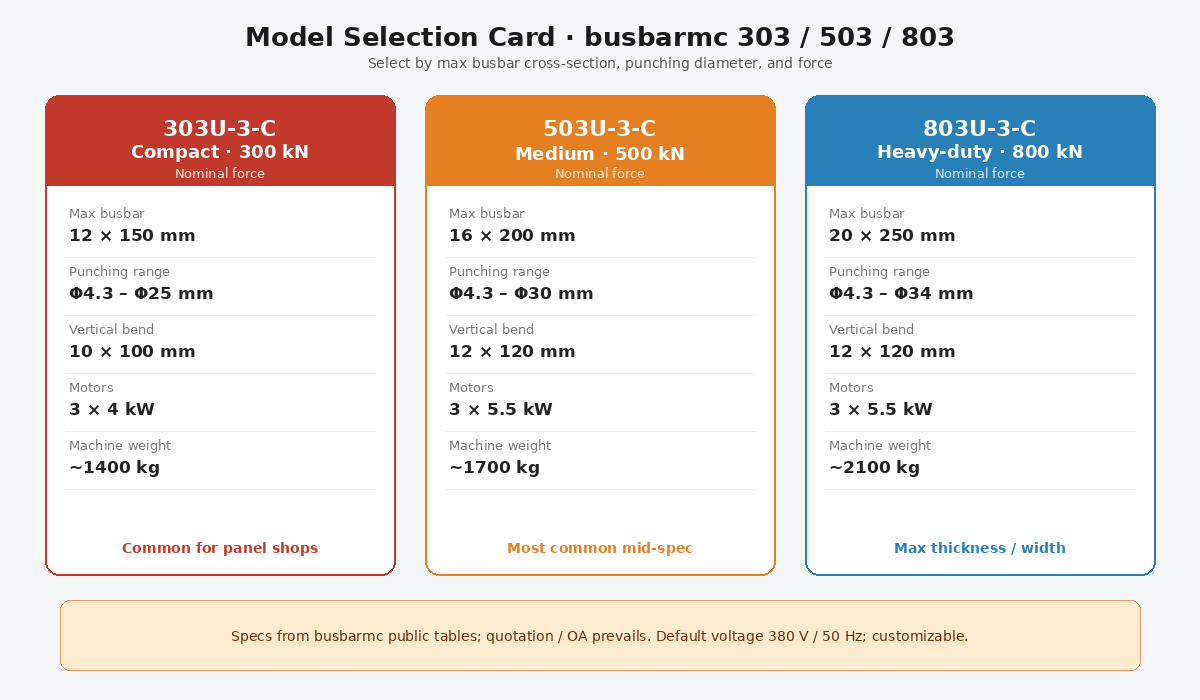
Model selection card: 303U-3-C / 503U-3-C / 803U-3-C
| Entity | 303U-3-C | 503U-3-C | 803U-3-C |
|---|---|---|---|
| Nominal force (kN) | 300 | 500 | 800 |
| Punching diameter (mm) | Φ4.3–Φ25 | Φ4.3–Φ30 | Φ4.3–Φ34 |
| Max thickness / width (mm) | 12 / 150 | 16 / 200 | 20 / 250 |
| Max horizontal bend (mm) | 150 / 12 | 200 / 16 | 250 / 20 |
| Max vertical bend size (mm) | 10×100 | 12×120 | 12×120 |
| Motor power | 3×4 kW | 3×5.5 kW | 3×5.5 kW |
Not always. CNC helps when positioning/setup is the bottleneck. Pure stroke speed is a weak KPI.
No. PLC/HMI mode libraries improve bend repeatability; a full CNC line adds feeding, nesting, and automation scope. Confirm the quote.
A side-by-side trial on your drawing with recorded conforming parts and changeover times.
Three independent pump groups, Siemens PLC bend modes, HMI recipes, and optional servo positioning—confirm options on OA.